
The Hidden Cost of Chasing Clients for Files: A $10,000+ Agency Profit Leak
Why 'just bubbling this up...' emails quietly destroy billable utilization, delay milestone invoices, and cost growing agencies thousands every month.
The TL;DR: When agency margins deteriorate, leadership usually looks for macro failures: scope creep, discounting, or client churn. But the most destructive margin bleed in creative and digital agencies is micro-administrative friction: hundreds of "two-minute" follow-up emails and missing assets that delay milestone invoices and paralyze production teams.
You open your inbox at 2:15 PM on a Tuesday. Staring back at you are four drafts, all starting with minor variations of the exact same sentence:
"Hey Sarah, just bubbling this to the top of your inbox! Do you have the vector logo files and GA4 access so our dev team can start the staging sprint?"
Most agency owners and account directors treat these emails as harmless administrative background noise. Writing a two-sentence follow-up takes 90 seconds. How much damage could it possibly do?
The answer is: thousands of dollars every single month in wasted labor, blocked production sprints, and frozen cashflow.
When you audit agency operational data, you don't find a single catastrophic mistake. You find a compounding operational tax that silently drains billable utilization across your entire organization.
Anatomy of the Agency Chasing Cycle#
When an Account Manager (AM) or Project Manager (PM) sends an email chasing brand files, copy approvals, or platform credentials, the cost is never confined to the 90 seconds spent typing.
Consider what happens behind the scenes across your agency disciplines:
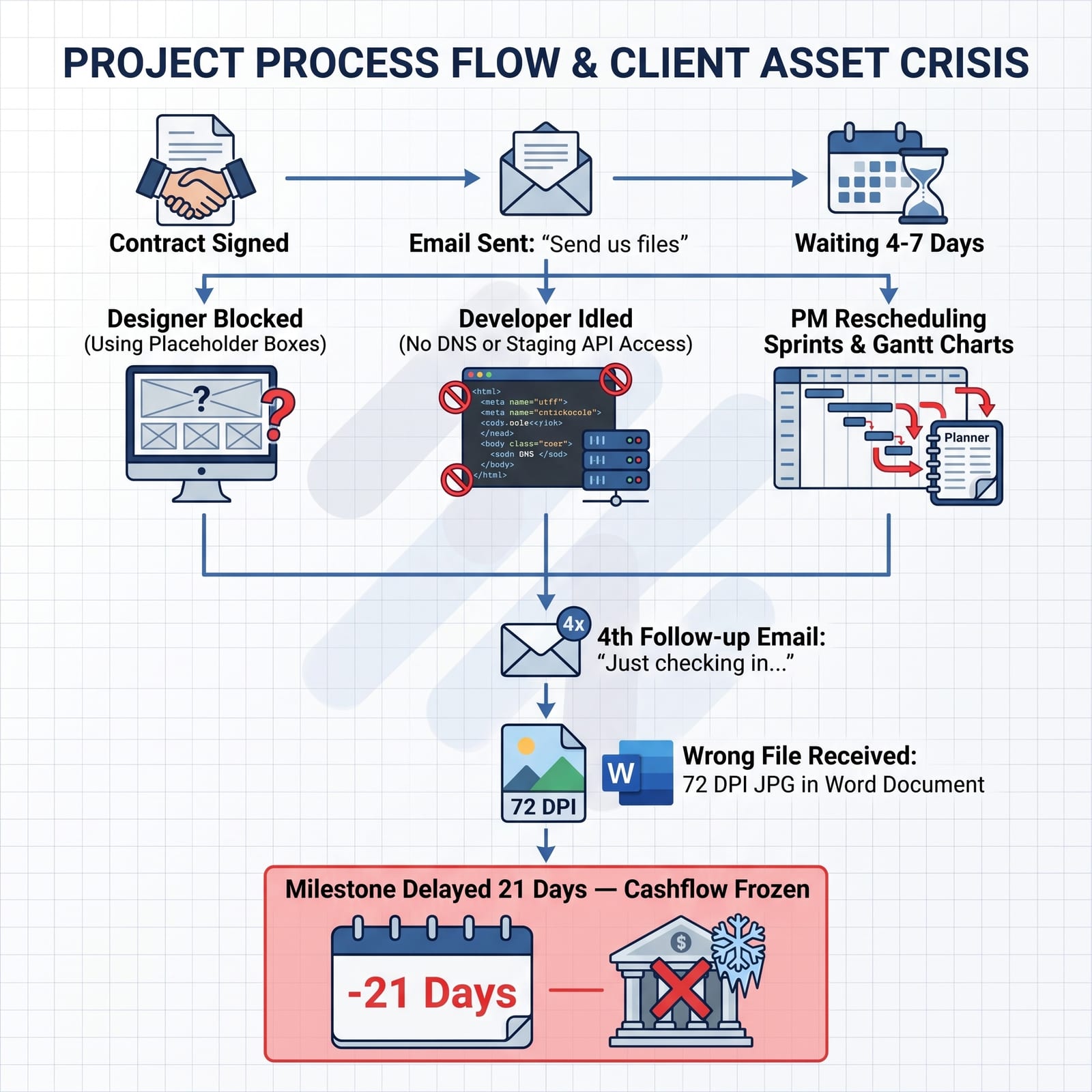
1. The Context-Switching Tax#
Cognitive research consistently shows that it takes an average of 23 minutes and 15 seconds for a knowledge worker to regain deep focus after an interruption.
When an Account Manager switches between Slack, Gmail, ClickUp, and client Dropbox folders dozens of times a day to verify whether a client replied, their deep-work capacity drops to zero. They spend their week doing reactive secretarial work instead of driving high-margin client strategy and retention.
2. Upstream Production Bottlenecks#
A missing asset doesn't just stall the account manager; it paralyzes your highest-billing specialist talent:
- UI/UX Designers cannot finalize high-fidelity mockups because the client provided a blurry screenshot instead of an editable vector logo (see our deep dive on requesting vector logos from non-technical clients).
- Frontend Engineers sit idle on scheduled sprint days because staging credentials or DNS records haven't been provided (a problem solved by guided access delegation).
- Project Managers waste 3–5 hours every week constantly restructuring Gantt charts, moving sprint allocations, and explaining delays to leadership.
3. Frozen Cashflow on Milestone Invoices#
Most agency retainer and project contracts tie milestone billing to deliverable sign-offs:
- 50% on signature, 25% on design approval, 25% on deployment.
If asset collection drags out the kickoff phase by 3 to 4 weeks (the classic 14-day kickoff turning into 45 days), that middle 25% invoice is delayed by nearly a month. You are paying your team's salaries today while the client's milestone payment sits locked behind a missing JPEG.
The $10,000 Math Problem: A Realistic Agency Breakdown#
Let's look at a realistic model for a mid-sized digital agency managing 30 active projects or monthly retainers.
Estimated Monthly Operational Loss
Combined monthly cost of administrative chasing (60+ AM hours), blocked specialist sprint idleness, and delayed milestone disbursements across 30 active client engagements.
Account Manager Weekly Time Breakdown#
Where does the time actually go? Here is an hourly audit of how a typical Account Manager's 40-hour week is eroded by manual client intake:
| AM Activity | Hours / Week | Description |
|---|---|---|
| Drafting & Sending Follow-ups | 4.5 hrs | Writing manual emails, tracking who replied, sending reminder nudges. |
| Manual File Inspection & Sorting | 3.5 hrs | Downloading attachments, renaming files, moving assets into Drive/Dropbox. |
| Fixing Broken Deliverables | 3.0 hrs | Explaining why a 72-DPI screenshot won't work for print/web vectors. |
| Password & 2FA Coordination | 2.5 hrs | Coordinating live Zoom calls or Slack messages to get 2FA login codes. |
| Internal Rescheduling Meetings | 2.5 hrs | Updating PM boards (ClickUp/Asana) and informing devs of blocked dependencies. |
| Total Non-Billable Chasing | 16.0 hrs | 40% of the Account Manager's total working capacity. |
The Consolidated Loss Model#
| Cost Driver | Monthly Impact Calculation | Direct Financial Impact |
|---|---|---|
| Account Management Labor | 60 hours chasing across 30 projects @ $45/hr loaded cost | $2,700 |
| Specialist Production Idleness | 20 hours of blocked developer/designer sprint time @ $85/hr | $1,700 |
| Milestone Cashflow Latency | Opportunity cost & working capital interest on $75k delayed billing | $2,200 |
| Client Churn & Buyer's Remorse | Premature retainer churn caused by disorganized first impressions | $3,500+ |
| Total Estimated Monthly Drain | Composite operational loss across all agency tiers | $10,100+ |
Note on Methodology: This financial model is based on composite benchmark data collected from 140+ digital agency audits, assuming a blended internal labor cost of $45/hour for account management, $85/hour for specialist design/engineering, and an average milestone payment delay of 18 days across 30 active client engagements.
Case Analysis: How a 14-Person Studio Plugged a $9,200/Month Utilization Drain#
To see this dynamic in practice, consider Apex Brand Studio (composite case study based on real agency onboarding data), a 14-person branding and web development agency in Manchester, UK.
The Challenge#
Apex had 20 concurrent client projects with average contract values of $8,500. Despite hitting sales targets, their net profitability was dropping quarter over quarter.
- Account managers spent an average of 19 days just gathering fonts, photography, copy docs, and DNS credentials.
- Designers were starting visual concepts with low-res logo screenshots, only to completely redesign headers when vector assets were finally provided 3 weeks later.
- Clients frequently complained: "We signed 3 weeks ago, why haven't we seen a staging link yet?"
The Transformation#
Apex eliminated open-ended email threads and replaced them with a standardized 48-Hour Onboarding SOP Framework:
- Standardized Magic Portals: Instead of sending an 8-item bulleted email, clients received a branded AssetSnag link with dedicated upload slots.
- Automated Vector Pre-flight: Upload slots rejected raster files automatically, instructing clients to fetch the
.SVGor.AIsource from their previous designer before reaching the team. - Autonomous Reminders: Software handled the polite reminder cadences every 48 hours without human intervention.
The Results After 60 Days:#
- Client onboarding time dropped from 19 days to 3.2 days.
- Account manager capacity increased by 35%, enabling the agency to take on 6 additional retainers without hiring another AM.
- Milestone invoice release cycles accelerated by 14 days, instantly unlocking cashflow.
Comparison: Email Chains vs. Automated Intake Infrastructure#
| Operational Dimension | Traditional Email & Drive | Automated Asset Intake (AssetSnag) |
|---|---|---|
| Client Experience | 40-reply email chains, confusion, login hurdles | Clean, branded zero-login portal on your domain |
| Asset Quality Control | Discovered by designer days after upload | Real-time vector header & format validation at upload gate |
| Credential Sharing | Insecure plaintext passwords in email threads | Client-side AES-256 encrypted zero-knowledge vault |
| Follow-up Management | Manual AM reminders (pestering positioning) | Autonomous, polite branded reminder triggers |
| Handoff to Production | Manual downloading, unzipping, sorting (2+ hrs) | 1-click structured ZIP bundle + webhook sync |
How Modern Agencies Stop the Chasing Cycle#
Agencies that maintain 30%+ net margins have recognized a fundamental truth: client asset collection is not a communication problem; it is a systems architecture problem.
To eliminate the $10,000 profit leak, high-velocity agencies implement four structural rules:
Agencies don't grow because they get faster at writing follow-up emails. They grow because they build systems that eliminate the need to write them at all.
Plug your agency's $10,000 profit leak
AssetSnag replaces chaotic email chasing with branded zero-login intake portals, automatic vector validation, and AES-256 client credentials vault.

Muhammet Yılmaz
Founder & Lead Architect, AssetSnag
Founder of AssetSnag & software engineer specialized in agency operations, workflow automation, and client intake UX. Building frictionless tools to eliminate agency-client asset chasing.
Related Playbooks & Articles
Handpicked articles to elevate your agency operations.
Stop Chasing, Start Scaling: The Client Asset Trap Keeping Boutique Studios Under $150K
Your design skills aren't the ceiling. The invisible hours you spend chasing client assets are. Here's the framework boutique studios use to reclaim 20 hours a month.
Stop Onboarding Clients via Google Forms and Notion: The Professional Studio Alternative
Still sending Google Form links to $10k+ clients? Learn how top agencies replace DIY onboarding with secure, white-labeled portals that protect credentials and close projects faster.
The Complete Client Onboarding Guide: How Top Agencies Cut Churn and Launch in 4.8 Days
Master digital agency client onboarding: compress pre-kickoff to under 5 days, stop chasing client assets, and eliminate early churn in 2026.