
Stop Chasing, Start Scaling: The Client Asset Trap Keeping Boutique Studios Under $150K
Your design skills aren't the ceiling. The invisible hours you spend chasing client assets are. Here's the framework boutique studios use to reclaim 20 hours a month.
If your boutique studio is stuck under $150K despite great work and happy clients, client asset chaos is likely the structural culprit: not your pricing, your portfolio, or your leads. Every unbilled hour you spend chasing logo files comes directly out of your pocket, and unlike a 20-person agency, you have no administrative buffer to absorb the damage.
You've opened another Gmail draft. It's the fourth version of the same email you've sent this client in three weeks.
"Hey Marcus, so sorry to keep bothering you! We're still waiting on the brand guidelines PDF and the social media login. Could you send those over when you get a chance? No rush at all!"
You hit send. You feel that familiar cocktail of guilt and quiet frustration. You just wrote another follow-up email that you'll never invoice for, chasing assets that should have arrived on day one, before the project even started.
This is the story of hundreds of boutique studio owners. Exceptional craft. Loyal, paying clients. A solid book of business built over years. And yet, month after month, the revenue line refuses to move past a ceiling that feels invisible but is very, very real.
The culprit is rarely your rates. It is almost never your portfolio. It is the operational drag hiding in plain sight: the Client Asset Trap.
The Boutique Studio Scaling Ceiling#
There's a specific revenue band where boutique studios stall (typically somewhere between $80K and $150K annually), not because of a lack of demand or talent, but because of a capacity crisis that disguises itself as a client communication problem.
When you run a studio of one to three people, every hour spent chasing assets is an hour stolen directly from billable production. Unlike a 20-person agency with a dedicated account manager to absorb the friction, you are the account manager, the designer, the developer, and the CFO simultaneously. When one of those roles bleeds into the others, the whole system degrades.
Of Studios Losing $1,000–$5,000 Monthly to Unbilled Admin Work
According to Ignition's State of Proposals & Payments report, the majority of agencies and studios lose thousands monthly to unbilled scope creep and administrative overhead, a problem that hits boutique operations hardest because there is no administrative buffer.
The 57% figure comes from Ignition's annual State of Proposals & Payments report, based on survey data from hundreds of freelancers and agency owners. The $1K–$5K monthly loss range reflects unbilled scope creep, rework caused by missing or incorrect assets, and administrative follow-up time that was never tracked against a project budget.
When every unbilled hour comes directly out of your pocket rather than a salaried employee's budget, the math changes dramatically. A 14-person agency losing $3,000/month to asset chasing is painful. A 2-person studio losing $1,200/month is existential. It is the difference between growth and treading water indefinitely.
Why Boutique Studios Are Hit Hardest#
The client asset problem carries four compounding effects on smaller studios that large agencies rarely feel with the same intensity.
1. You Have No Administrative Absorption Layer#
At a 20-person agency, there is likely a dedicated project manager or client success role whose entire function is to absorb the friction of asset collection. At a 2-person studio, that friction lands directly on the person whose time is the most valuable and the least replaceable: you.
When your morning begins with three follow-up emails and a round of Slack messages before you've opened a single design file, you've already surrendered 40 minutes of your most cognitively productive window to work that generates zero revenue.
2. One Stalled Project Freezes Everything#
Large agencies run parallel project tracks. If one client is slow to respond, production resources shift to another. Boutique studios rarely have that luxury. When your most significant active client project stalls because they haven't sent brand guidelines, your entire production queue stops. This is the hidden leverage that makes asset chaos uniquely catastrophic at smaller scale.
3. Missing Assets Silently Create Scope Creep#
The damage isn't just the time spent chasing; it's the invisible rework loop that follows:
- Designer builds mockups using placeholder assets or pulls an approximate logo from the client's existing website.
- The "correct" brand assets arrive three weeks later.
- Designer rebuilds all affected components.
- You absorb the rework cost entirely, because the contract reads "final logo provided."
This loop is precisely where the unbilled thousands disappear. You cannot easily charge for it, and at boutique scale, you cannot afford to eat it. For a full breakdown of how this compounds at agency level, see our deep dive on the hidden cost of chasing clients for files.
4. Late Assets Cascade Directly into Late Payments#
Most studio contracts tie milestone payments to deliverable sign-offs. When asset delays push a kickoff by three or four weeks (a dynamic examined in why your 14-day kickoff actually takes 45 days), that second invoice is delayed by nearly a full month. You continue paying for tools, subscriptions, and your own time while the client's payment waits behind a missing vector file.
What "Normal" Looks Like, and Why It's Broken#
Most boutique studios have assembled a practical-feeling tool stack for client intake: an email thread here, a Google Drive folder there, a shared Notion page, a WhatsApp message for quick credential handoffs. It feels workable. Until it doesn't.
"We used to spend more time looking for the right version of a client's logo across Slack and email than we did actually designing the homepage."
Creative Director, Boutique Design Studio
The problem isn't any single tool. It is the fragmentation. When a client has to upload assets in one place, send credentials in another, and confirm approvals in a third, cognitive load overwhelms even the most willing client. They drop off, forget, or submit the wrong file format, forcing you to absorb the consequences.
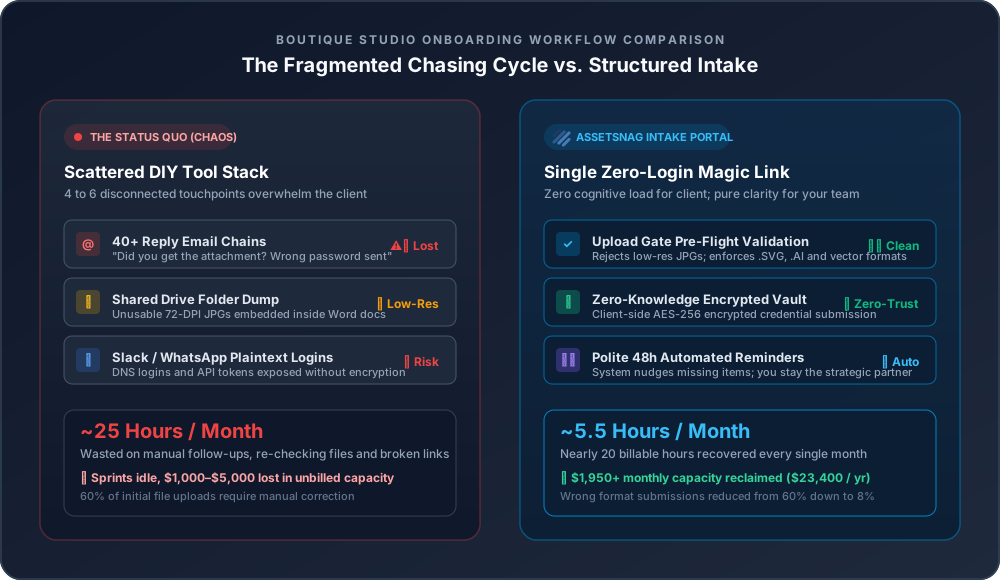
On average, studios use between four and six disconnected tools just for client intake. Each handoff point is an opportunity for the client to disengage, submit the wrong format, or simply forget. For a full breakdown of why DIY tools structurally fail at onboarding, read our analysis of why Google Forms and Notion sabotage your client intake.
| Operational Metric | Fragmented Stack (Email / Drive / Notion) | Structured Intake Portal |
|---|---|---|
| Asset Collection Time | ~25 hours per month | ~5.5 hours per month |
| Wrong Format Submissions | ~60% of initial uploads | ~8% (enforced at upload gate) |
| Client Credential Security | Plaintext in emails, Slack, Notion | Encrypted zero-knowledge vault |
| Follow-up Responsibility | 100% manual, falls on you | Automated, no human required |
| First Impression Signal | Fragmented, DIY-looking process | Branded, professional, cohesive |
Building a Zero-Chase Studio#
The goal is not to become a faster, more organized chaser. The goal is to architect a studio workflow where chasing is structurally unnecessary because the system handles it, or better yet, eliminates the need entirely through format enforcement at the source.
The Zero-Chase Studio Setup
The Math on Your Recovered Capacity#
If a structured intake system reduces your asset collection time from 25 hours per month to 5.5 hours, you recover approximately 19.5 hours of billable capacity. At a modest boutique studio rate of $100 per hour, that totals:
$1,950 per month in recovered revenue, achieved without hiring anyone, without raising your rates, and without winning a single new client.
Projected over 12 months: $23,400 in recoverable annual revenue sitting quietly inside your existing client relationships, locked behind a process problem that has a structural solution.
That is not a pricing problem. That is not a positioning problem. It is a systems problem, and systems problems respond to systems solutions.
Frequently Asked Questions#
How much revenue do boutique studios typically lose to unbilled administrative work?#
Industry data from Ignition shows that 57% of agencies lose between $1,000 and $5,000 monthly to unbilled scope creep and administrative overhead, with 30% losing more than $5,000. For boutique studios under five people, the relative impact is even higher because there is no administrative buffer to absorb the damage.
What is the fastest way to stop chasing clients for assets?#
Replace open-ended email requests with a structured, zero-login intake portal that enforces file formats at upload and sends automated reminders on your behalf. The goal is to remove yourself entirely from the follow-up loop.
Does switching to an intake portal really reduce onboarding time?#
Yes. Agencies replacing email-based collection with automated intake portals reduce asset collection time from roughly 25 hours per month to under 6 hours, recovering approximately 19 hours of billable capacity monthly without hiring anyone.
Is the client asset problem different for boutique studios versus large agencies?#
Critically different. A 20-person agency has a dedicated account manager whose role exists to absorb this friction. A 2-person studio has no such buffer. Every hour of asset-chasing comes directly out of the owner's billable production window, which is why the scaling ceiling hits boutique studios so much harder.
High-Ticket Agency Client Onboarding & Security Kit
The battle-tested 48-hour onboarding system used by top digital agencies to eliminate file delays, protect client passwords, and kickoff projects 3× faster.
Build your zero-chase studio today
AssetSnag gives boutique studios a branded intake portal, format enforcement at upload, and automated reminder cadences, helping you stop chasing client assets and start scaling.

Muhammet Yılmaz
Founder & Lead Architect, AssetSnag
Founder of AssetSnag & software engineer passionate about killing agency operational bottlenecks.
Related Playbooks & Articles
Handpicked articles to elevate your agency operations.
Stop Onboarding Clients via Google Forms and Notion: The Professional Studio Alternative
Still sending Google Form links to $10k+ clients? Learn how top agencies replace DIY onboarding with secure, white-labeled portals that protect credentials and close projects faster.
The Complete Client Onboarding Guide: How Top Agencies Cut Churn and Launch in 4.8 Days
Master digital agency client onboarding: compress pre-kickoff to under 5 days, stop chasing client assets, and eliminate early churn in 2026.
Why Your Agency's 14-Day Project Kickoff Takes 45 Days (And How to Fix the Client Limbo)
A deep dive into why agency client onboarding fails, the hidden cost of the 'telephone game' for credentials, and how zero-login portals are changing the game.