
The Security Blind Spot in Agency Onboarding: Plaintext Credentials vs. Zero-Knowledge Delegation
Why collecting client credentials and API keys via email creates liability, and how client-side zero-knowledge encryption solves agency onboarding risk.
The Core Thesis: Digital agencies routinely demand root-level infrastructure, DNS, and payment gateway access from clients during kickoff. Transmitting and storing these secrets over unencrypted communication channels introduces severe regulatory liabilities under GDPR and KVKK, creates friction with enterprise IT, and introduces credential-stuffing attack vectors into internal tools.
In modern web development and digital agency workflows, account provisioning is an unavoidable prerequisite. Delivering a custom Webflow build, configuring headless Shopify environments, or deploying infrastructure on Cloudflare requires elevated privileges:
- DNS provider access (Cloudflare, Route 53, GoDaddy)
- Payment gateway credentials and production API tokens (Stripe, Lemon Squeezy, Paddle)
- Server access keys, SSH key pairs, and transactional mail provider secrets
- Third-party analytics and tracking tags (GA4, Meta Conversions API)
Despite the sensitivity of these credentials, agency intake workflows treat credential delegation as an informal task. Secrets are routinely pasted into kickoff emails, Slack direct messages, Notion documents, and shared spreadsheets.
This approach creates measurable security risks, operational friction, and compliance violations before engineering work even begins (driving the hidden cost of administrative client chasing).
The Technical Vulnerabilities of Traditional Credential Gathering#
Collecting secrets through general-purpose communication tools breaks foundational zero-trust security principles in three specific ways:
1. Plaintext In-Transit and At-Rest Exposure#
When a client pastes a Cloudflare password or a Stripe Secret Key (sk_live_...) into an email draft:
- The secret is stored unencrypted across multiple mail server relay logs.
- It remains accessible to any employee with mailbox read permissions.
- It persists indefinitely in agency email archives, backups, and local client caches.
If an account manager's email account is compromised, the attacker gains access not only to internal communications, but also to the production infrastructure of every client that manager has onboarded over their tenure.
2. Multi-Factor Authentication (MFA) Synchronization Failures#
When clients share their direct username and password instead of delegating role-based access, automated security systems flag the login:
- Geographic and device mismatch triggers an immediate MFA challenge.
- The authentication code is delivered to the client’s mobile device.
- Communication latency causes the time-based token (TOTP) or SMS code to expire before the agency developer can submit it.
This introduces operational deadlocks, turning simple deployments into multi-day scheduling conflicts (causing kickoffs to balloon from 14 into 45 days; see how role-based access delegation solves this).
3. The Shared Spreadsheet / Notion Antipattern#
To make credentials accessible across project teams, agencies frequently consolidate client logins into centralized internal databases (most commonly Notion, Airtable, or Google Sheets).
This creates a high-value, unencrypted honeypot. These internal databases:
- Rarely enforce granular, role-based access control (RBAC) per project.
- Lack cryptographic hardware key (FIDO2/WebAuthn) requirements for read access.
- Retain valid production credentials years after the client contract has concluded, creating unmanaged liability.
Architectural Comparison: Informal Intake vs. Zero-Knowledge Infrastructure#
A secure onboarding pipeline isolates sensitive intake data from general communications, utilizing cryptographic guarantees rather than organizational trust.
| Security & Operational Vector | Unstructured Intake (Email, Slack, Sheets) | Shared Password Managers | Client-Side Zero-Knowledge Vault |
|---|---|---|---|
| Encryption State | Plaintext at rest; unencrypted transit | Encrypted at rest on centralized provider servers | Client-side AES-GCM-256; zero-knowledge server state |
| Client Friction | Low barrier, but triggers immediate MFA failure loops | High barrier (requires client account creation & extension installs) | Zero-Login: Single-use cryptographic token access |
| Credential Persistence | Indefinite; remains in chat/email archives forever | Persistent until manually purged by team admins | Ephemeral; auto-shreds upon one-time team decryption |
| Auditability | Zero logging of who accessed credentials | Audit logs available within provider application | Tamper-evident intake logs with IP & timestamp verification |
| Compliance Posture | Direct violation of GDPR/KVKK storage minimization | Compliant, dependent on provider configuration | Native compliance via end-to-end client-side encryption |
The Solution: A Zero-Knowledge Ingest Pipeline#
The structural resolution is to implement a dedicated Pre-Project Intake Layer equipped with an in-browser cryptographic vault.
This model treats client secrets as temporary, single-use cryptographic payloads rather than permanent reference documentation.
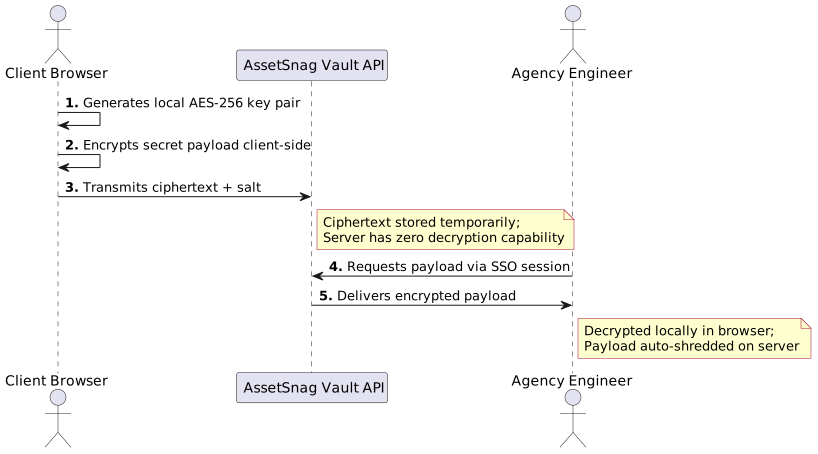
Technical Workflow:#
- Tokenized, Zero-Login Session: The client accesses an onboarding portal via a cryptographically signed magic link. No third-party account registration or master password setup is required on their end.
- In-Browser Encryption: When the client inputs DNS credentials or API keys, encryption occurs locally inside the browser using the Web Crypto API (AES-GCM with a 256-bit key).
- Zero-Knowledge Storage: The server receives only the ciphertext, initialization vector (IV), and salt. The application backend has no access to the plaintext value or the derived private key.
- Single-Use Decryption & Ephemeral Lifecycle: When the assigned technical lead claims the credentials to configure environments or delegate permissions, the payload decrypts inside their authorized session.
- Automated Shredding: Once the credential is confirmed and infrastructure roles are established, the temporary record is automatically purged from the database, eliminating lingering security risks.
Operational Advantages of Protocol-Driven Delegation#
Decoupling sensitive credential intake from informal communication channels provides measurable business and operational advantages:
- Enterprise IT Buy-In: Enterprise security and procurement departments routinely reject agency onboarding that relies on shared logins. Providing an encrypted, single-use vault satisfies corporate data security standards immediately.
- Elimination of Access Deadlocks: Clear intake flows instruct clients to configure delegated, limited-privilege accounts (such as Cloudflare Account Members or Shopify Collaborators) rather than sharing primary administrative logins.
- Zero Ongoing Liability: When a project concludes, your agency holds no unmanaged, dormant client credentials in internal documentation tools.
Conclusion: Intake Is a Security Boundary#
In modern web development, the boundary between an agency and a client's core digital infrastructure is razor-thin. Treating client credential gathering as an informal, ad-hoc administrative step is no longer acceptable engineering practice.
By standardizing client onboarding through structured intake portals with zero-knowledge encryption, agencies can eliminate MFA synchronization loops, protect client assets, and ensure full regulatory compliance from day zero (see our 48-Hour Onboarding Framework for full implementation details).
Secure Your Agency Intake Pipeline
AssetSnag combines zero-login client portals with client-side zero-knowledge encrypted vaults to make asset and credential collection secure, compliant, and friction-free.

Muhammet Yılmaz
Founder & Lead Architect, AssetSnag
Founder of AssetSnag & software engineer specialized in agency operations, workflow automation, and client intake UX. Building frictionless tools to eliminate agency-client asset chasing.
Related Playbooks & Articles
Handpicked articles to elevate your agency operations.
How to Securely Collect Client Passwords (Without Failing GDPR)
Learn why collecting client passwords via Slack or email is a massive GDPR risk, and how digital agencies can securely gather credentials during onboarding.
The Complete Webflow Client Handoff Checklist: Safe Ownership Transfer & Access Revocation
A technical guide for Webflow agencies on securely transferring workspace ownership, rotating API keys, and cleaning up permissions during client handoff.
The Hidden Danger of Client DNS Access (And How to Secure It)
Stop asking clients for their GoDaddy passwords in plaintext. Learn how to securely manage DNS delegation without breaking MX records or risking security breaches.